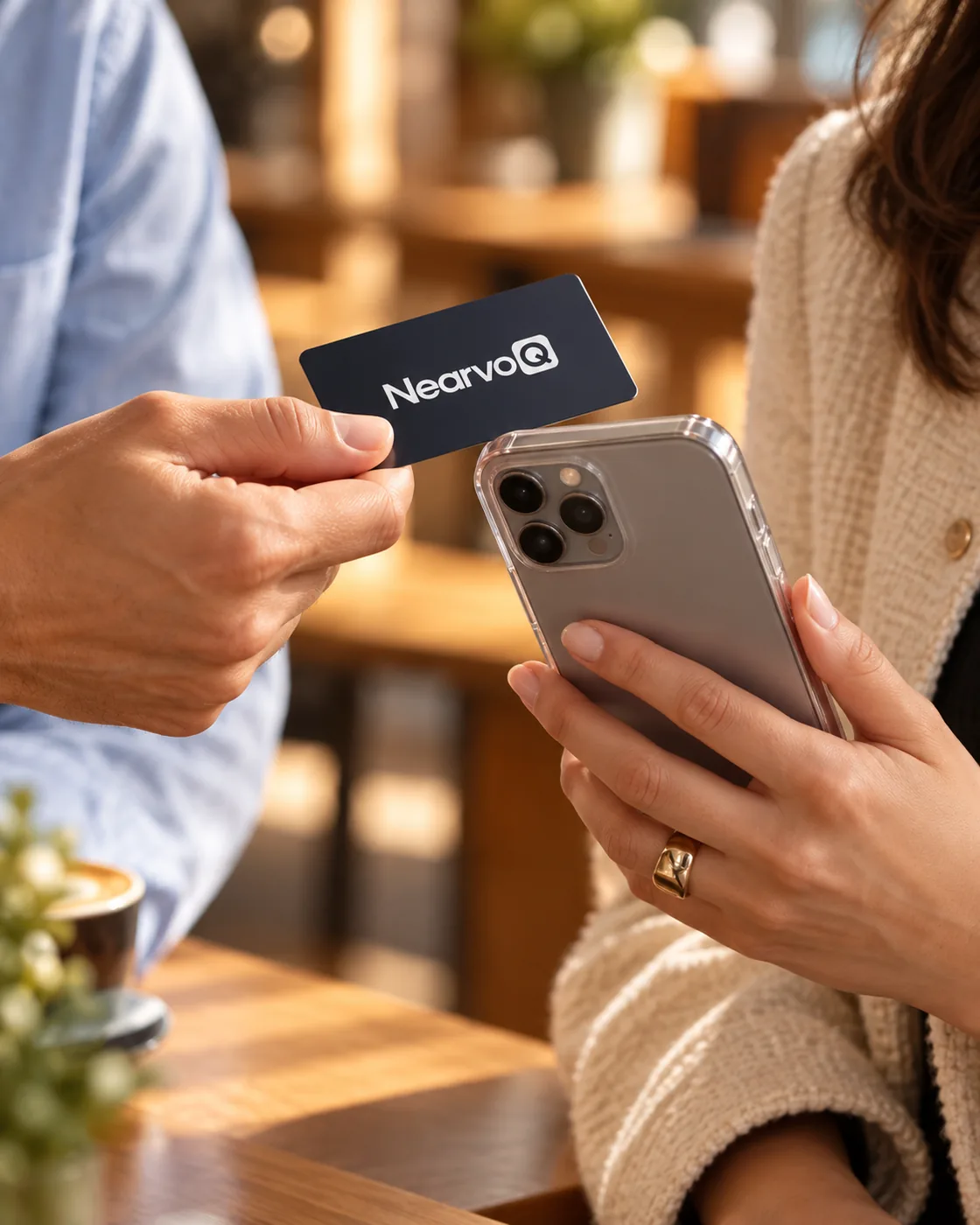
NFC in plain language
NFC is a way for two devices to exchange a tiny amount of data by being almost touching. A phone has a small antenna that creates a weak field. When a chip, called a tag, is inside that field, the chip powers up from the phone's signal and sends back what it stores. The chip needs no battery.
That stored data can be a web address. So an NFC business card holds a link, and tapping a phone to it opens that link. How NFC business cards work walks through what happens after the tap.
What people use NFC for
| Use | Example | Needs the phone to do |
|---|---|---|
| Contactless payment | Paying at a terminal with a phone | Use a wallet app and your payment details |
| Tags and cards that open a link | A business card, a menu sign, a Google review card | Read the tag and open the link |
| Transit and access | Some tickets and building passes | Depends on the system |
| Pairing and sharing | Some accessories and file sharing | Depends on the phone and software |
Does my phone have NFC?
iPhone
Recent iPhones can read NFC tags in the background with the screen on and unlocked. Apple documents the models in its background tag reading guide; see where to tap on an iPhone.
Android
Open Settings and search for NFC. If it is there, switch it on. Google's steps are in its Android Help article; see how to turn on NFC on Android.
Try a card
Hold a card or tag to the back or top of the phone for about a second. If nothing happens, check NFC is on, remove a thick case and try the other end of the phone.
What NFC is not
- It is not Bluetooth or Wi-Fi. It works only at a few centimeters.
- A passive tag only stores data read at close range; it cannot track your location by itself. If it opens a website, that site can record interactions and an approximate location. NearvoQ counts eligible card opens and profile interactions.
- A card is not always readable through thick metal or a heavy case.
- Not every phone reads every tag, which is why a business card also carries a printed QR code. See NFC vs QR code.
NFC, QR codes and Bluetooth compared
| NFC | QR code | Bluetooth | |
|---|---|---|---|
| Range | A few centimeters | Anywhere a camera can see it | Several meters |
| Needs a battery in the tag | No | No (it is printed) | Yes, in the device |
| Setup for the person using it | Tap; Android may need NFC switched on | Point the camera | Pairing and permissions |
| Good for | Quick taps on a card, tag or terminal | Printed material and screens | Headphones, speakers, accessories |
That is why a business card carries both an NFC chip and a printed QR code: one covers phones that cannot tap, the other covers a tap that does not read.