What an NFC business card actually does
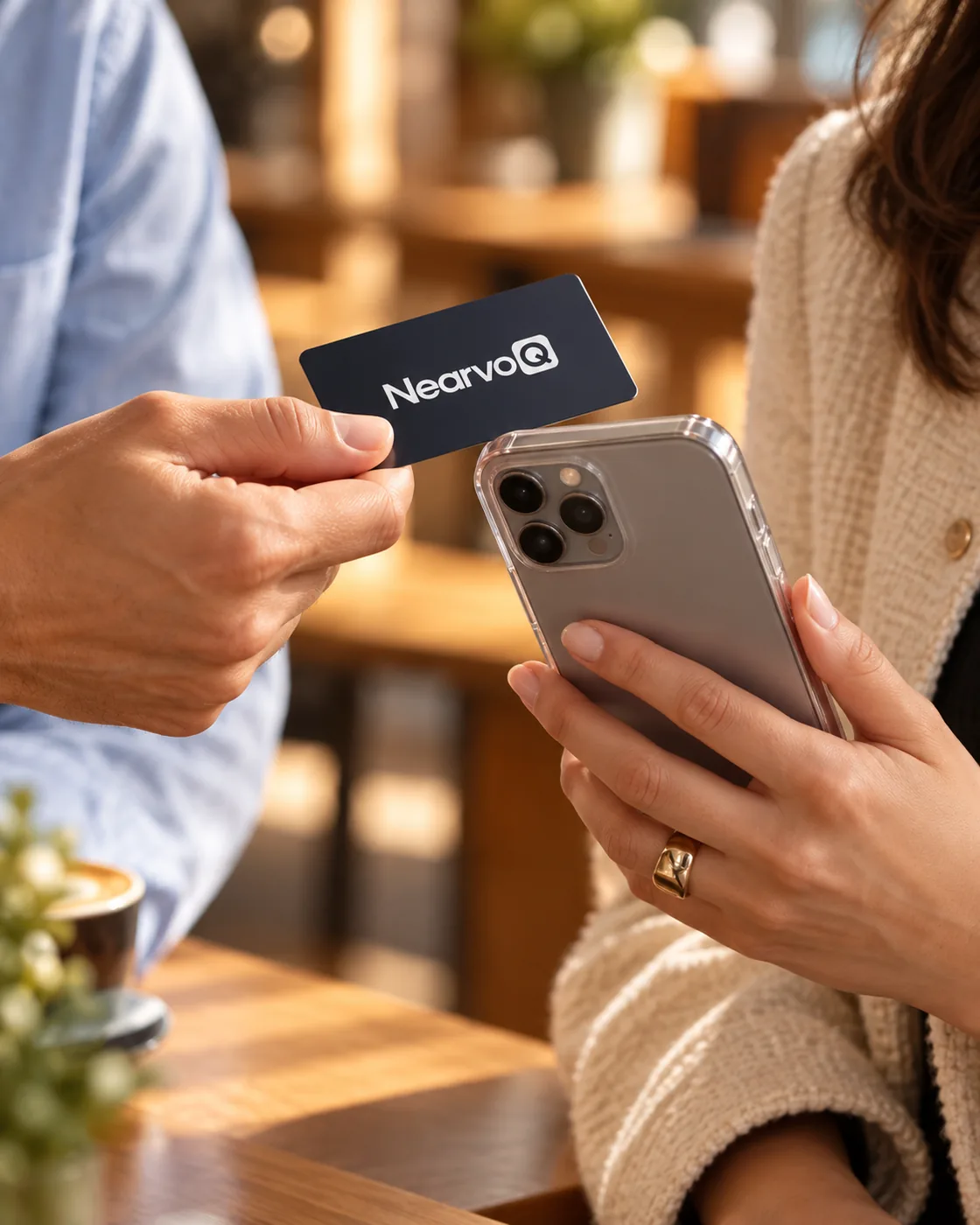
NFC stands for near-field communication. It's the same short-range radio your phone uses for tap-to-pay, except here the card only hands over one thing: a web address. There's no battery, no Bluetooth pairing and nothing to charge. The chip is powered by the phone for the fraction of a second it takes to read it.
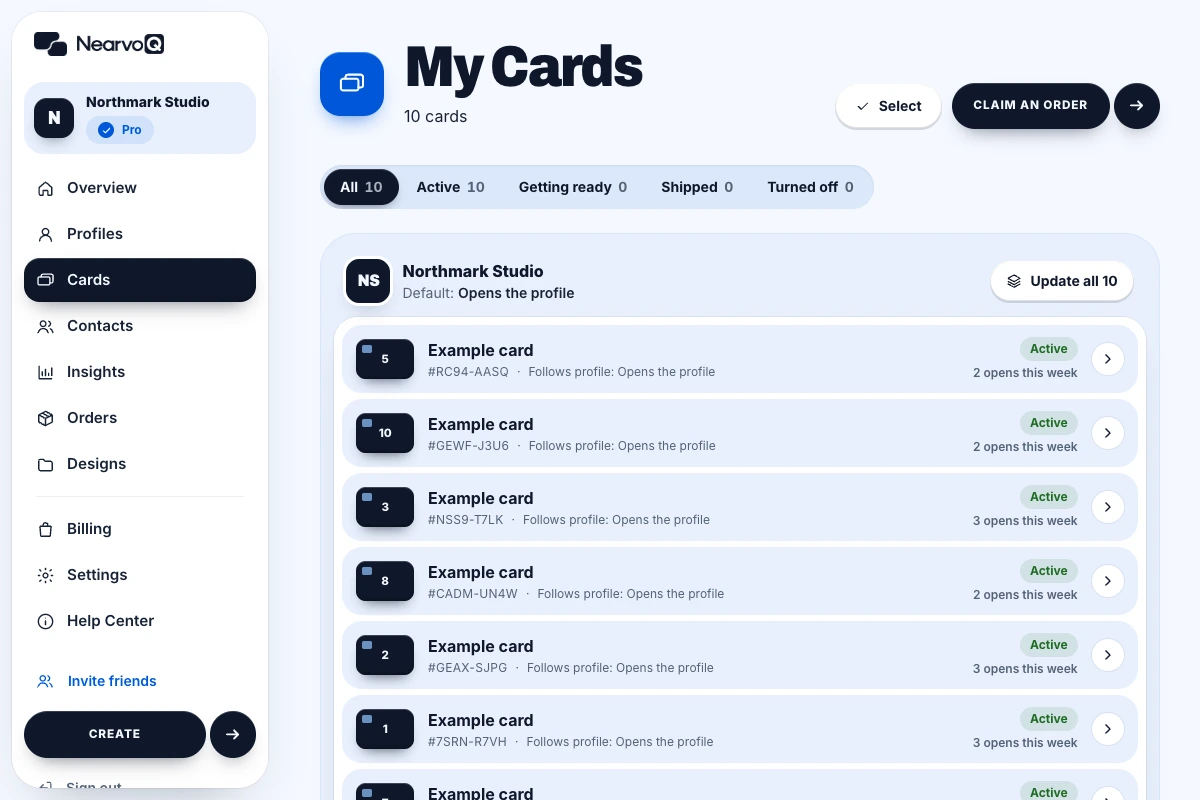
That web address is what matters. A cheap NFC card stores your final link directly on the chip, so if your website, booking page or job title changes, the card is out of date. A NearvoQ card stores a permanent NearvoQ link instead (nearvoq.com/t/… on the chip and nearvoq.com/q/… in the printed QR code). When someone taps, that link looks up where the card should go right now. You change the destination in your account and every card follows on the next tap. How changing the link works.
How someone uses your card
On most iPhones from the iPhone XS onward and on Android phones with NFC switched on, the person just holds your card near the phone and a notification appears. Tapping it opens the page. No app is needed on either side.
Not every phone taps, and that's fine. Every NearvoQ card is printed with a QR code that opens the same destination with the camera, so the card still works on older phones, on phones with NFC turned off and in thick cases. Where to tap on an iPhone and how to turn NFC on for Android cover the details.

Maya Torres
Founder & Strategy LeadNorthline Advisory
Strategy for growing teams
One card, more than one job
Most NFC cards are sold for one purpose. A NearvoQ card points wherever you need it this month:
- Your contact profile, with a Save contact button that adds you to their phone in one step.
- Your Google review page, so customers can leave a review while they're still in front of you. Google review cards.
- A booking page (Square, Calendly, Vagaro or any scheduling link) for salons, barbers, consultants and trainers.
- A menu for restaurants and cafés, kept current without reprinting.
- Instagram, TikTok, LinkedIn or any other profile, or simply your website.
- A different place per card. One card at the counter opens reviews, the one in your wallet opens your profile.
What NearvoQ NFC cards cost
Basic cards are $19.99 each with the NearvoQ design. Custom cards are $29.99 each with your own design from the studio. The $10.00 difference only pays for the custom print; the software is identical. You pay once per card. The free plan keeps every card working with no time limit.
| Cards in the order | Basic | Custom |
|---|---|---|
| 1–4 | $19.99 | $29.99 |
| 5–9 (−5%) | $18.99 | $28.49 |
| 10–24 (−10%) | $17.99 | $26.99 |
| 25–49 (−15%) | $16.99 | $25.49 |
| 50–99 (−20%) | $15.99 | $23.99 |
| 100–249 (−25%) | $14.99 | $22.49 |
| 250–1,000 (−30%) | $13.99 | $20.99 |
The whole order gets the price of the largest step it reaches. US shipping is free from $49.00, otherwise $6.99; local delivery in Fargo, West Fargo and Moorhead is free.
NearvoQ compared with a basic NFC card and a paper card
| NearvoQ card | Static NFC card | Paper card | |
|---|---|---|---|
| Opens on tap | Yes, plus a printed QR code | Yes, QR depends on the seller | No |
| Change where it goes | Anytime, online, on every card at once | Only by rewriting the chip, if it isn't locked | Reprint |
| Free profile page | Yes | Usually not | No |
| See taps and scans | Yes (7 days on Free, longer on Pro) | Destination analytics only | No |
| Ongoing cost | None required | None | Reprints |
A static NFC card is fine when the link will never change. If it might, the permanent link is what you're paying for. Static vs dynamic NFC cards.
From order to first tap
Design or pick Basic
Start in the 3D card studio with your logo, or order the ready-made Basic card.
Pay on Stripe
Checkout is on Stripe. Shipping is free in the US from $49.00, otherwise $6.99, and local delivery in Fargo, West Fargo, Moorhead is free.
Choose where the cards go
After payment you pick the first destination. New cards start on your free profile, which you can fill in while they ship.
Tap and change anytime
Cards usually arrive within 5 to 7 days of payment (an estimate, carrier transit included). Change the destination whenever you like from your account.
When an NFC card isn't the right choice
If you hand out hundreds of cards at a trade show to people you'll never meet again, cheap paper cards with a QR code may be the better buy. NFC earns its price when the card stays with you (shown at a counter, kept in a wallet, handed to the right people) or when you need the link to stay current.
It also helps to be honest about what a review card does. It makes leaving a review faster; it doesn't create reviews or change your rating. Google's rules still apply, so ask every customer the same way and never offer anything in return. How to ask for Google reviews.
Choose the card destination
Fictional Northmark Studio example account. Activity shown is example data, not customer results.